Viking-style jewelry for men runs from a Thor’s hammer pendant to a silver arm ring or a ring carved with runes. Some of those designs really are from the Viking Age. Others, like the so-called Viking compass, come from Icelandic manuscripts written centuries later. Here is what the archaeology shows, what each symbol is known to have meant, where a few have been misused, and how to choose a hammer pendant and chain in sterling silver.
Key takeaways
- Thor’s hammer pendants are real Viking Age amulets. About 1,000 have been found, in silver, gold, bronze, iron, and other materials.
- The valknut appears in Viking Age finds such as the Oseberg ship burial, but its original name and meaning are unknown.
- The vegvísir, sold as a “Viking compass,” comes from 19th-century Icelandic grimoires, not the Viking Age.
- Silver was Viking wealth: arm rings showed status, and silver was cut up and valued by weight.
- The ADL says white supremacists have appropriated the hammer and the valknut, but non-racist pagans use them too, so judge them in context.
- Match the chain to the pendant’s weight: 3 mm up to 12 g, 4 mm up to 20 g.
In this guide Thor’s hammer Valknut Later symbols Arm rings In context Choosing one FAQ
Thor’s hammer: the real Viking pendant
In Norse myth, Mjölnir is the hammer of Thor, the thunder god. Small hammer-shaped pendants of silver, gold, bronze, iron, and other materials are known from the Viking Age, which the Danish archaeologist Else Roesdahl dates from the late 700s to the mid-1000s, and they were especially popular in the last pagan period as a counterpart to the Christian cross, she writes in the Danish encyclopedia Lex. About 1,000 have been found across the Nordic countries, the British Isles, the Baltic, and Russia, and Roesdahl notes that they turn up especially in women’s graves.
Skeptics had questioned whether the little pendants, with their short handles, showed a hammer at all. A find in 2014 confirmed it: a hammer amulet from Købelev, on the Danish island of Lolland, about 2.5 cm (1 inch) tall and dated to the 900s, carries the runes “hmar x is,” “hammer is,” with the x as a word divider. The National Museum of Denmark’s runologist Lisbeth Imer rendered it in modern Danish as “This is a hammer,” Videnskab.dk reported. It is the only one of the roughly 1,000 known with runes.
The old and new faiths overlapped. The National Museum of Denmark holds a soapstone mold from Trendgården in northern Jutland, dated to the second half of the 900s, that was made for casting both Thor’s hammers and crosses, Lex notes.
The hammer is still a religious symbol. Today it is “a major symbol for those who follow neo-Norse religions such as Asatru,” according to the ADL, and the US Department of Veterans Affairs lists the “Hammer of Thor” as emblem No. 55 among the emblems of belief it offers for government headstones.
The valknut: an old symbol with a modern name
The valknut is three interlocked triangles. The motif appears on a carved bedpost from the Viking Age Oseberg ship burial in Norway and on picture stones from Gotland, Sweden. An Anglo-Saxon gold ring in the British Museum, found in the River Nene in England and dated to the 8th or 9th century, has a bezel “decorated with three incised interlaced triangles.”
What the Vikings called it, and what it meant to them, isn’t known. “Valknut,” usually translated “knot of the slain,” is a modern name, and because the symbol appears beside figures read as Odin and among burial goods, scholars have proposed links to Odin, notably Hilda Ellis Davidson, and Rudolf Simek has suggested it may have been tied to religious practices around death, as Wikipedia’s summary of the research sets out. Those are interpretations, not a recorded meaning.
Later symbols: the vegvísir and the helm of awe
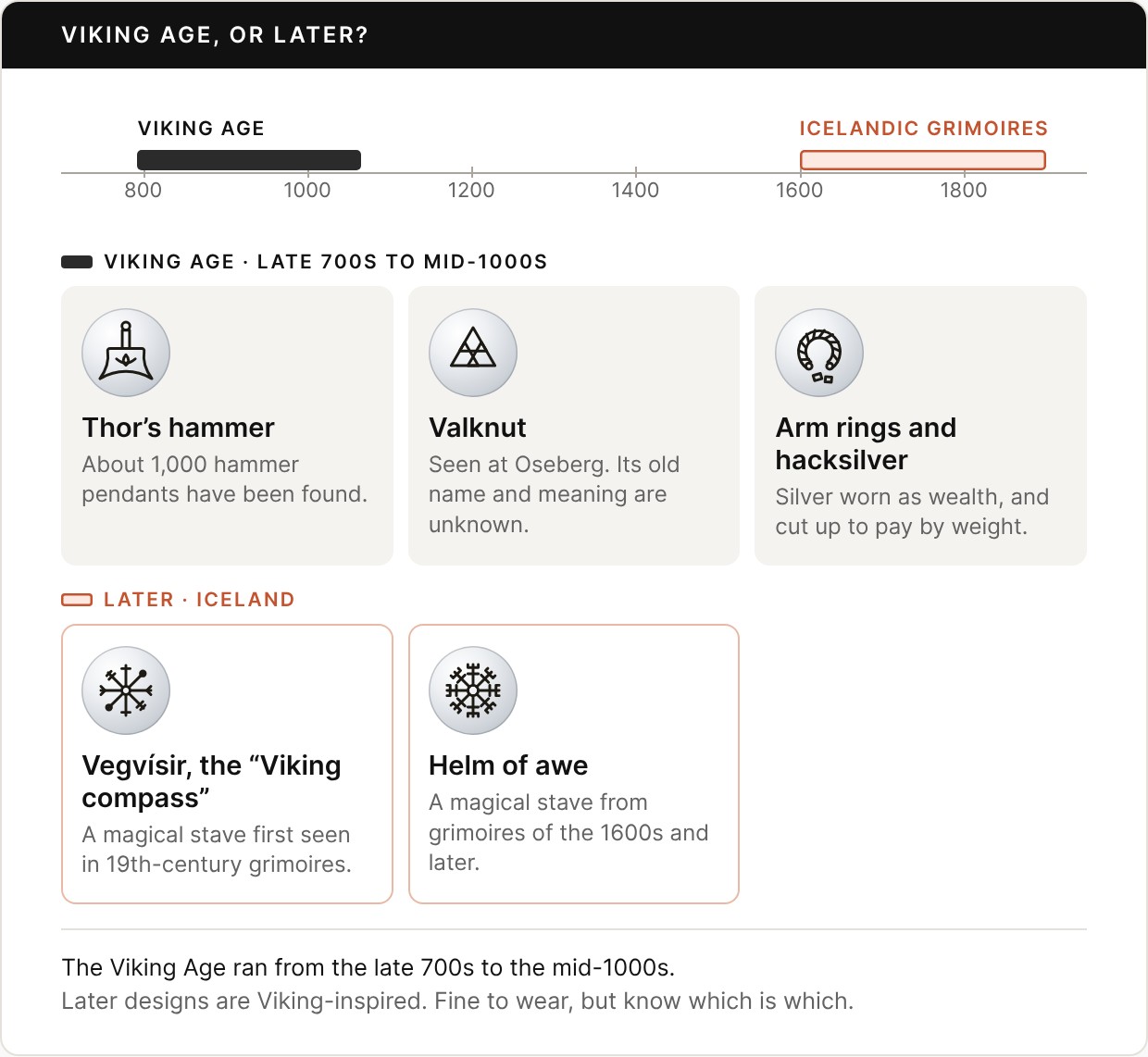
Two designs often sold as “Viking” come from Iceland, long after the Viking Age. The vegvísir, sold as a Viking compass, is a magical stave: the symbol “can be found in three Icelandic grimoires from the 19th century,” the first and most important being the Huld manuscript compiled by Geir Vigfússon in Akureyri, writes Tomáš Vlasatý of the Czech reenactment project Projekt Forlǫg. The idea that it guided Viking ships, he wrote in 2019, “can only be found in popular literature though, and in romantic fiction created in the past 30 years.”
The drawn stave called the helm of awe, or ægishjálmur, is Icelandic too; the Museum of Icelandic Sorcery and Witchcraft lists one in a 17th-century grimoire. Both are fine to wear for the design or for what they mean to you. Just don’t buy one as an ancient Viking relic.
Arm rings and the Viking silver economy
Silver mattered to the Vikings as money as much as ornament. The Vale of York hoard, found by two metal detectorists in 2007, held “a gilded silver cup, 617 coins, 67 silver objects and a single gold arm-ring,” according to York Museums Trust. “Arm-rings were visual displays of the wealth of the owner,” the museum’s Andrew Woods writes, and leaders “were described as ‘ring-givers.’”
Much of the silver in the hoard had been cut up into hacksilver, and some pieces carry small nicks made to test the metal, “due to the fact that Vikings often valued silver according to its bullion, or weight, value,” Woods explains. A modern silver cuff or arm ring nods to that tradition; our comparison of cuffs and chain bracelets covers fit, and our guide to what sterling silver is worth explains its value as metal today.
Wearing Norse symbols in context
Many people wear a hammer or a valknut for heritage, faith, or the design. White supremacists have also adopted these symbols, and the ADL lists all three below in its hate symbol database while stressing that each has to be judged in the context in which it appears:
- Thor’s hammer. Its “traditional origins are non-racist,” and most Asatruers today are not racist, the ADL says, but neo-Nazis and other white supremacists have appropriated it and “will often even create racist versions,” adding swastikas or other hate symbols. Despite that “widespread use,” one “should never assume that the Thor’s Hammer appearing by itself necessarily denotes racism or white supremacy.”
- Valknut. Some racist Odinists use it, but “non-racist pagans may also use this symbol,” so the ADL says to examine it in context.
- Othala rune. Nazi Germany used it in the insignia of two Waffen SS divisions, and white supremacists commonly use it today, though it also appears in non-extremist runic writing, according to the ADL.
The practical rule: skip any piece that pairs Norse symbols with swastikas or other Nazi-era imagery, and know what a symbol can signal before you wear it. Our guides to symbols on men’s bracelets and Claddagh and Celtic rings cover other symbols worth understanding first.
Choosing a hammer pendant and chain
Viking Age hammers were small: the Købelev amulet is about an inch tall, close to the 23 to 25 mm that our guide to pendant size counts as medium. A larger hammer suits a broad build or a pendant worn over a T-shirt.
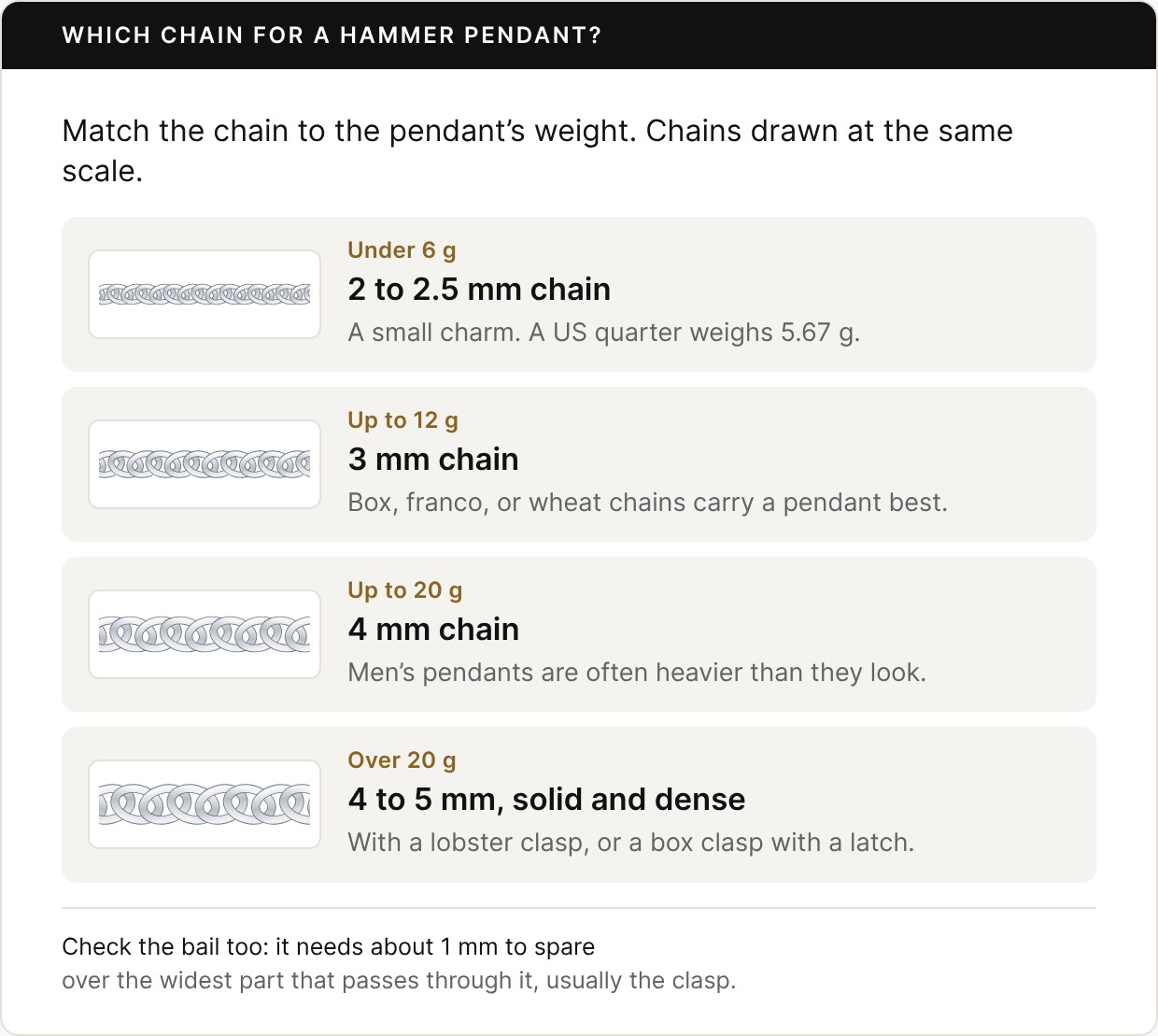
- Chain width. Follow the pendant’s weight, as our guide to the best chain for a pendant explains: 2 to 2.5 mm under 6 g, 3 mm up to 12 g, 4 mm up to 20 g, and a solid, dense 4 to 5 mm chain above that. If the listing gives no weight, a kitchen scale will; for reference, a US quarter weighs 5.67 g.
- Chain style. Box, franco, and wheat chains carry a pendant best.
- Bail. The opening needs about 1 mm to spare over the widest part that passes through it, usually the clasp.
- Length. A pendant hangs 1″ to 2″ below the chain, so 22″ suits most men and 24″ a large pendant or a broad build; our chain length guide has the details.
- Metal. Look for a 925 or sterling stamp, as our guide to telling if silver is real explains. If the hammer has a darkened, oxidized finish, clean it as our guide to oxidized silver describes.
FAQ
Is Thor’s hammer a real Viking symbol?
Yes. About 1,000 hammer pendants from the Viking Age have been found, and one from Købelev, Denmark, is inscribed in runes “hmar is,” “hammer is,” rendered in modern Danish as “This is a hammer.”
What does the valknut mean?
Nobody knows what it meant to the Vikings, and its name is modern. Because of where it appears, scholars have proposed links to Odin and to religious practices around death, but those are interpretations.
Is the vegvísir a Viking symbol?
No. It is an Icelandic magical stave first recorded in 19th-century grimoires. The “Viking compass” story comes from recent popular literature.
Is it offensive to wear a Thor’s hammer?
Not in itself. The ADL says the hammer is a major symbol for followers of Asatru and that one should never assume it denotes racism when it appears by itself. Avoid versions combined with swastikas or other hate symbols.
Did Vikings wear silver?
Yes. Hammer pendants were made in silver among other materials, arm rings displayed wealth, and silver was cut into hacksilver and valued by weight.
What chain should I wear with a Mjolnir pendant?
Go by weight: 3 mm up to 12 g, 4 mm up to 20 g, and a solid, dense 4 to 5 mm chain above that. A box, franco, or wheat chain carries a pendant best, and 22″ suits most men.
Bottom line
Thor’s hammer is the real thing: a Viking Age pendant, about 1,000 of which have been found, and still a religious symbol today. The valknut is old too, though its meaning is lost; the vegvísir and the helm of awe are later Icelandic staves. Wear any of them knowing which is which, and skip anything combined with hate symbols. For a sterling hammer, match the chain to its weight and the length to your build.
From the collection
Men’s sterling silver rings by Ronatelli
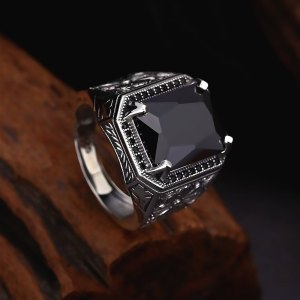
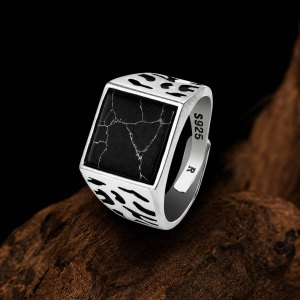
Eleven handmade 925 rings, $129 to $169, from a chain-link band to a black onyx statement ring. Every one is adjustable.
Related guides
Thor’s hammer finds, dates, materials, and the Trendgården mold follow Else Roesdahl’s “thorshammer” in Lex (updated December 21, 2025); the Købelev runes follow Videnskab.dk (June 13, 2014), quoting the National Museum of Denmark. The valknut follows the British Museum’s record for the River Nene ring and Wikipedia’s summary of the research. The vegvísir follows Tomáš Vlasatý (Projekt Forlǫg); the helm of awe follows the Museum of Icelandic Sorcery and Witchcraft. The Vale of York hoard follows Andrew Woods for York Museums Trust. Symbol context follows the ADL’s hate symbol database; the headstone emblem follows the US Department of Veterans Affairs. Chain and pendant sizing follow our own guides. Ring prices in the collection box were read from ronatelli.com. All were checked on October 31, 2026. Read our editorial policy.

