Lab-grown diamonds in sterling silver are now turning up in designer collections. On October 21, John Hardy released a 21-piece collection co-designed with Billie Eilish and Finneas, in sterling silver, with lab-grown diamonds in some of the pieces and prices from $195 to $2,400, according to National Jeweler. The pairing makes sense on price: lab-grown stones keep getting cheaper, and silver keeps the metal cost low. This guide covers what a lab-grown diamond is, what the label should say, how to tell one from moissanite and cubic zirconia, what a report proves, what the stone is worth, and what to check in the silver setting.
Key takeaways
- It’s diamond, made in a lab. Lab-grown diamonds have nearly the same chemical, optical, and physical properties as mined ones, GIA says. Moissanite and cubic zirconia are simulants, not diamonds.
- The label should say so, up front. Under the FTC’s Jewelry Guides, “laboratory-grown,” “laboratory-created,” or a similar term should come right before “diamond,” just as prominent. The Guides aren’t regulations, but the FTC can act against ads that ignore them.
- A diamond tester can’t tell lab-grown from mined. That takes specialized instruments; for a larger stone, look for a report you can check online.
- Buy it for how it looks, not as a store of value. Wholesale prices fell 26% in 2025 and kept falling in 2026, according to JCK.
- The silver is the weak link. Check the 925 stamp, the plating, and the prongs; a bezel or flush setting protects a stone best on a ring that takes knocks.
In this guide What it is The label Look-alikes Reports Price and value The setting Care FAQ
What a lab-grown diamond is
A lab-grown diamond is diamond: the same crystal structure of tightly bonded carbon atoms, grown in a lab instead of formed in the earth, with “nearly the same chemical, optical and physical properties as natural diamonds,” according to GIA. By eye, the difference can be impossible to see.
Most are grown in one of two ways. In the high-pressure, high-temperature (HPHT) method, carbon crystallizes on a diamond seed under conditions that mimic the earth’s interior. In chemical vapor deposition (CVD), carbon from a hydrocarbon gas settles on a diamond seed plate in a vacuum chamber, layer by layer. HPHT presses can also be used to treat a diamond’s color, GIA notes.
That sets lab-grown diamonds apart from simulants. Cubic zirconia, moissanite, and glass only imitate diamond and are “completely unrelated to diamonds at the atomic level,” GIA says. Moissanite makes the most convincing stand-in, since its hardness and its ability to conduct heat approach diamond’s, and our guide to moissanite tennis chains covers it in detail.
What the label should say
Because a lab-grown diamond is a diamond, the FTC’s Jewelry Guides focus on making sure you know it wasn’t mined. The Guides set out how the FTC reads advertising claims; they aren’t regulations, but the FTC can act against ads that don’t follow them. Sellers should use terms such as “laboratory-grown,” “laboratory-created,” or “[manufacturer name]-created,” the FTC explains in its advertising guidance, and its 2019 warning letters to diamond sellers spell out the placement: immediately before the word “diamond,” with equal conspicuousness.
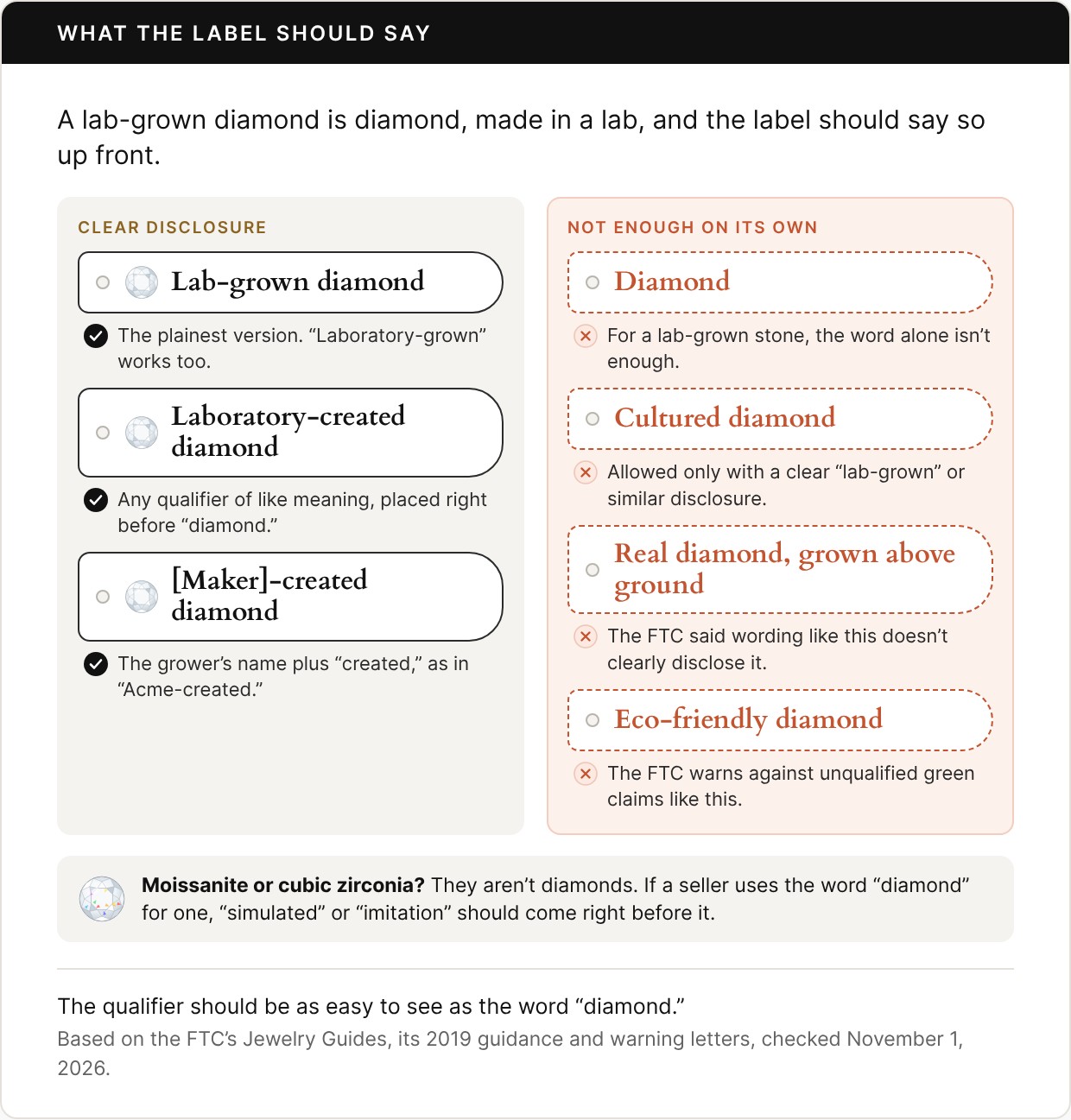
- “Diamond” alone should mean mined. As Sara Yood, now president and CEO of the Jewelers Vigilance Committee, told National Jeweler about the FTC’s 2018 changes to the Guides, “if you are using the word ‘diamond’ unqualified, you are still talking about a natural diamond.”
- “Cultured” needs a partner. The FTC’s Guides allow “cultured” for a lab-grown diamond only with a clear and conspicuous disclosure, such as “laboratory-grown” or “laboratory-created,” that the stone wasn’t mined. You may also see “synthetic diamond”: the FTC dropped “synthetic” from its list of examples in 2018 but didn’t ban it, National Jeweler notes.
- “Real” doesn’t cover it. In a 2019 letter to one lab-grown seller, the FTC said “aboveground real diamonds” and “Real diamonds created in America” didn’t clearly and conspicuously disclose that the stones were laboratory-created. And the FTC still holds that “real,” “genuine,” “natural,” and “precious” can’t be used for lab-grown stones, National Jeweler notes.
- Green claims need proof. The FTC’s 2019 letters also warned against unqualified environmental claims such as “eco-friendly,” which the FTC said sellers are highly unlikely to be able to substantiate, and noted that buyers may read “sustainable” as a claim of environmental benefit.
Simulants get a stricter rule: a seller who uses the word “diamond” for moissanite or cubic zirconia should put “imitation,” “simulated,” or a similar word right before it, just as prominently, so it’s clear the stone isn’t a diamond at all.
Lab-grown diamond, moissanite, or cubic zirconia?
In a small silver setting, the three can be hard to tell apart, and a quick test won’t sort them all out.
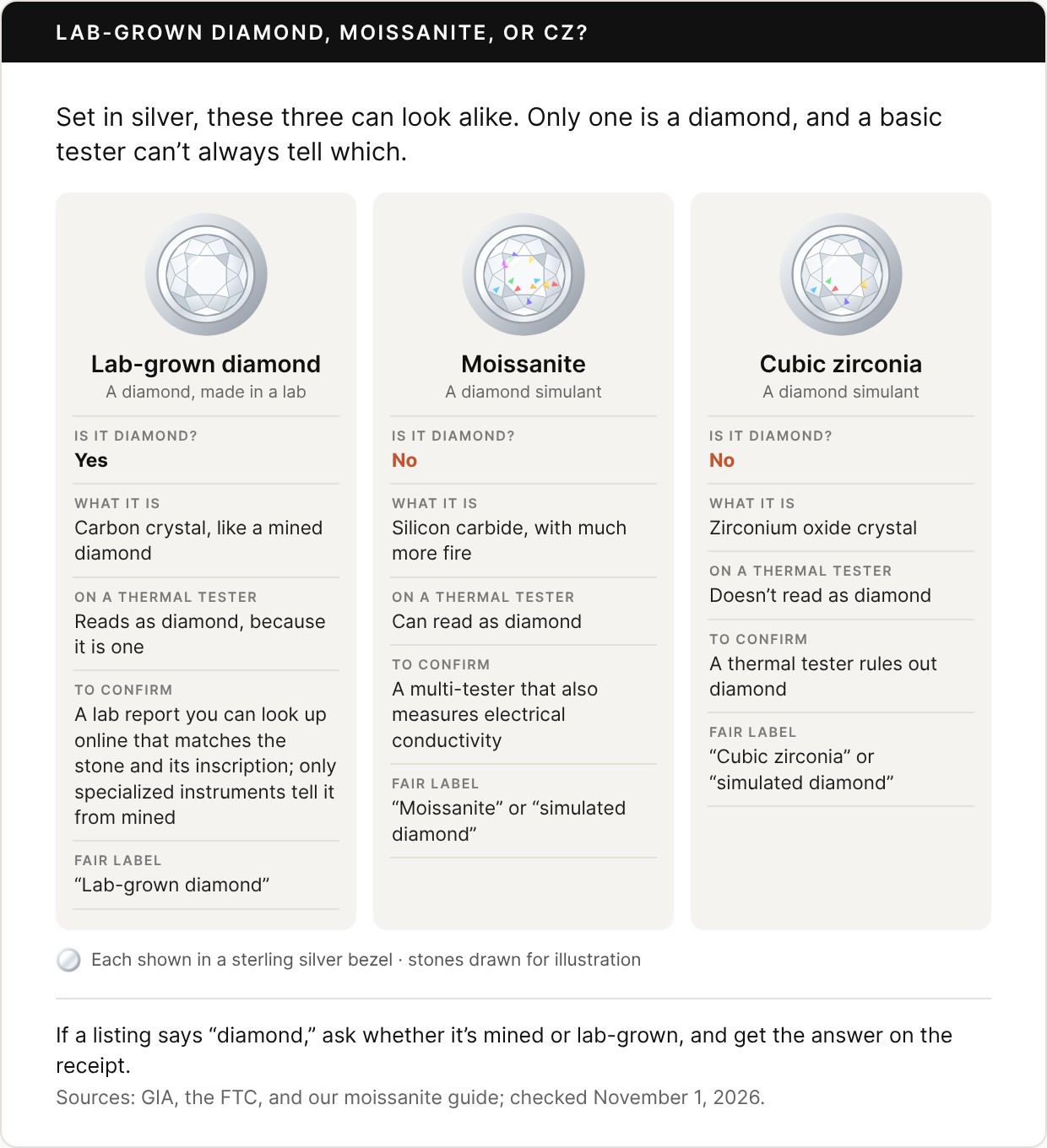
- A diamond tester tells you less than you’d think. A basic thermal tester separates diamond from cubic zirconia, but moissanite can fool it, as our moissanite guide explains. And a lab-grown diamond reads as diamond because it is one.
- Lab-grown vs. mined takes a lab. Telling them apart comes down to tiny atomic-level irregularities in the crystal that specialized equipment can detect, GIA says. Its lab uses instruments such as the DiamondView imaging system, and it makes a desktop tester for jewelers, the iD100, that screens a stone in under two seconds. Small stones are the hardest: in one batch of 359 tiny yellow diamonds GIA screened, 14 turned out to be lab-grown, yet the stones “all displayed uniform appearance and could not be distinguished visually,” according to GIA.
- So the paperwork matters. For a piece with small accent stones, the disclosure on the listing and the receipt is your record. Ask the seller to write “lab-grown diamond” on the receipt, with the total carat weight.
What a report does and doesn’t tell you
GIA changed how it reports on lab-grown diamonds in 2025. It stopped using the color and clarity grades it developed for natural diamonds, noting that more than 95% of lab-grown diamonds entering the market fall into a very narrow range of color and clarity, according to its June 2025 announcement. Since October 1, 2025, it has issued a GIA Laboratory-Grown Diamond Quality Assessment that classes a stone as “Premium” or “Standard,” and gives no designation to stones below its minimums, according to GIA.
- Premium: D color, VVS clarity or higher, excellent polish and symmetry, and, for round brilliants, an excellent cut grade.
- Standard: at least J color, VS clarity, very good polish, very good symmetry (good for fancy shapes), and, for round brilliants, a very good cut grade. A stone can mix Premium and Standard marks and still qualify.
- The inscription: GIA laser-inscribes each stone’s girdle with “Laboratory-Grown” and its assessment number.
- The size floor: GIA assesses stones of 0.15 carat and up, so small accent stones won’t have one. Existing GIA reports for lab-grown diamonds remain valid, GIA said in June 2025.
Other labs issue their own reports for lab-grown stones. Whichever lab it is, look the report number up on that lab’s own website and check that the details match the stone you received. Even a matching inscription isn’t proof on its own, as our moissanite guide explains: GIA once examined a moissanite inscribed with a real GIA report number that belonged to a natural diamond.
What it costs, and what it’s worth later
Lab-grown diamonds keep getting cheaper at wholesale. Wholesale prices for loose lab-grown stones fell 26% in 2025 and were down 14% year over year in the first quarter of 2026 and 13% in the second, according to analyst Edahn Golan’s price lists, as reported by JCK in August. His wholesale index is down 96% since he began tracking in 2018, and a 3-carat, D-color, VVS round sold for about $126 a carat at wholesale in the first quarter of 2026. Retailers still mark lab-grown stones up by more than 80% over wholesale, according to analyst Paul Zimnisky, cited in the same article.
Two things follow. Buy a lab-grown piece because you like it, not as a store of value: with wholesale prices falling this fast and retail markups above 80%, don’t count on getting much back if you sell it. And in silver, the metal won’t make up the difference: the silver in a typical 6 mm men’s band is worth only about $9 to $13 at $50 an ounce, and a scrap buyer pays less than that, as our guide to what sterling is worth shows.
- “ct. t.w.” is the total of every stone. A ring marked “1/2 ct. t.w.” has about half a carat of diamonds in total, across all its stones, not a single half-carat diamond. Fractions are approximate, too: a diamond described as 1/2 carat could weigh between 0.45 and 0.54 carat, the FTC explains, and sellers using fractions should say the weight isn’t exact.
- Compare like with like. Set a lab-grown piece against the same design in mined diamond or moissanite, at the same total weight, and ask each seller what the stones are.
Checking the silver setting
A diamond is the hardest thing in the piece; the sterling around it is not. Silver “is naturally softer and more susceptible to scratches and dents than white gold,” GIA writes, so the setting is what to inspect.
- The stamp. Look for 925 or STERLING, often inside a ring or on the clasp, as our guide to what 925 means explains. A yellow piece stamped 925 is gold-plated silver, not gold.
- The plating. Many stone-set silver pieces are rhodium-plated for a brighter, whiter finish, and the plating wears, as our rhodium guide explains. Ask what the plating is if the listing doesn’t say.
- The prongs. Every stone should sit level, with each prong snug over its edge. Prongs should be “checked occasionally to ensure they remain secure,” and their raised edges can sometimes catch on fabric, according to GIA’s guide to ring settings.
- Bezels for hard wear. A bezel, a rim of metal around the stone, offers “excellent protection for the edges of the stone” and resistance to chips and everyday wear, GIA says. For a man’s ring that gets knocked, a bezel or flush setting is the safer pick. A pavé band, with many tiny stones held in soft silver, needs regular checks; GIA notes pavé rings may need occasional maintenance to keep the stones secure.
For earrings, the size advice in our men’s earrings guide holds for lab-grown studs, and our online store checks apply to any seller you don’t know.
Caring for lab-grown diamonds in silver
- Clean it gently. Warm water, a drop of mild dish soap, and a soft toothbrush, the method our guide to cleaning sterling silver gives for hard stones, suit a diamond and the silver around it.
- Skip the ultrasonic. Vibration can loosen stones in their settings, so keep stone-set silver out of ultrasonic cleaners, our ultrasonic guide advises.
- Store it apart, in its own bag. Stone-set pieces will scratch your other silver, as our moissanite guide notes; for marks that do appear, see our guide to scratches on silver rings.
- Have the prongs checked every six months to a year, as our wedding band guide suggests for any ring, and sooner if a stone moves or a prong catches.
FAQ
Are lab-grown diamonds real diamonds?
Yes. They have the same crystal structure as mined diamonds and nearly the same chemical, optical, and physical properties, according to GIA. What differs is where they formed, and the label should say so.
Can a jeweler tell a lab-grown diamond from a mined one?
Usually not by eye, and not with a basic diamond tester. It takes specialized instruments, such as GIA’s iD100 or the equipment in a gem lab. For a larger stone, a lab report you can look up online is the practical check.
Does a lab-grown diamond pass a diamond tester?
Yes, because it is diamond. That is why “passes the diamond tester” tells you nothing about whether a stone was mined or grown, and moissanite can pass a basic thermal tester too.
Is a lab-grown diamond in sterling silver worth it?
It can be, as jewelry: you get a diamond for less than a mined one would cost, in a metal that keeps the price down. It isn’t an investment. Wholesale prices for lab-grown stones have fallen sharply, and the silver in a typical men’s band is worth only about $9 to $13 at $50 an ounce.
What does “1/2 ct. t.w.” mean?
Carat total weight: all the diamonds in the piece add up to about half a carat. It doesn’t mean a single half-carat stone, and fractional weights are approximate.
Is “cultured diamond” the same as lab-grown?
It describes the same thing, but the FTC allows “cultured” only with a clear and conspicuous disclosure, such as “laboratory-grown” or “laboratory-created,” that the stone wasn’t mined.
Bottom line
A lab-grown diamond in sterling silver is a diamond for less than a mined one would cost, and a fair buy when it is sold as what it is. Check that the label says lab-grown, laboratory-created, or the maker’s name plus created, right before “diamond”; get it in writing; look for a report and an inscription on a larger stone; and inspect the silver: the stamp, the plating, and the prongs. Then buy it to wear, not to resell.
Related guides
The John Hardy collection follows National Jeweler (October 22, 2026). What lab-grown diamonds are, how they are grown and identified, GIA’s reports, settings, and silver’s softness follow GIA (its lab-grown diamond pages, its June 2 and August 26, 2025 announcements, its guide to ring settings, and “White Gold vs. Silver”). Labeling follows the FTC’s Jewelry Guides, its 2019 advertising guidance, and its March 2019 letters to diamond sellers, with Sara Yood’s comment and the FTC’s position on “real,” “genuine,” “natural,” and “precious” as reported by National Jeweler. Prices follow JCK (August 10, 2026), citing Edahn Golan and Paul Zimnisky. Stamps, plating, testers, and care follow our own guides. All were checked on November 1, 2026. Read our editorial policy.

