A typical ad: a silversmith retiring after 40 years, everything 80% off, the sale ending soon. Some of these stores are real; many are not. In May 2026, ABC News found dozens of online retailers, jewelry sellers among them, using AI-generated images and videos to pose as struggling craftspeople and small business owners. This guide covers what the fake ones have in common, the checks that take about ten minutes before you pay, the silver-specific signs a listing can’t hide, how to pay so you can get your money back, and what to do if you’ve already ordered.
Key takeaways
- Fake “closing sale” stores sell a story (a retiring maker, a small shop in trouble), discount deeply, often 70% or more and sometimes up to 90%, and push a deadline; AI makes the photos and videos cheap to produce.
- Before you pay, search the store’s name with “scam” or “complaint,” check when its website was registered, reverse-search its photos, and look for a real address and a return policy.
- For silver, the price has to cover the metal: at late-October 2026 prices, a solid 5 mm Cuban chain at 22″ holds roughly $44 to $73 of silver, so a “solid 925” one at $19.99 isn’t one.
- Pay by credit card, which you can dispute; the FTC says a seller that insists on a gift card, a wire transfer, a payment app, or crypto is probably a scam.
- If you’ve already ordered, contact your card issuer right away, keep every record, report the store at ReportFraud.ftc.gov, and ignore anyone who charges to “recover” your money.
In this guide The pattern Ten-minute check Silver red flags How to pay Already ordered? Real small sellers FAQ
What fake jewelry stores have in common
Shopping scams are common, and many start in a social feed: reported losses to scams that began on social media rose eightfold from 2020 to 2025. In the FTC’s data for 2025, shopping scams were the most reported kind of scam that began on social media, and more than 40% of people who lost money to a social media scam said they had ordered something they saw in an ad, the agency said in April 2026. The BBB’s 2025 Risk Report found that online purchase scams made up 28.4% of the scams reported to its Scam Tracker in 2025 and that 89.3% of them involved a money loss; jewelry was the eighth most mentioned product in online purchase and counterfeit reports, and online purchase scams were among the report types where mentions of AI appeared most often.
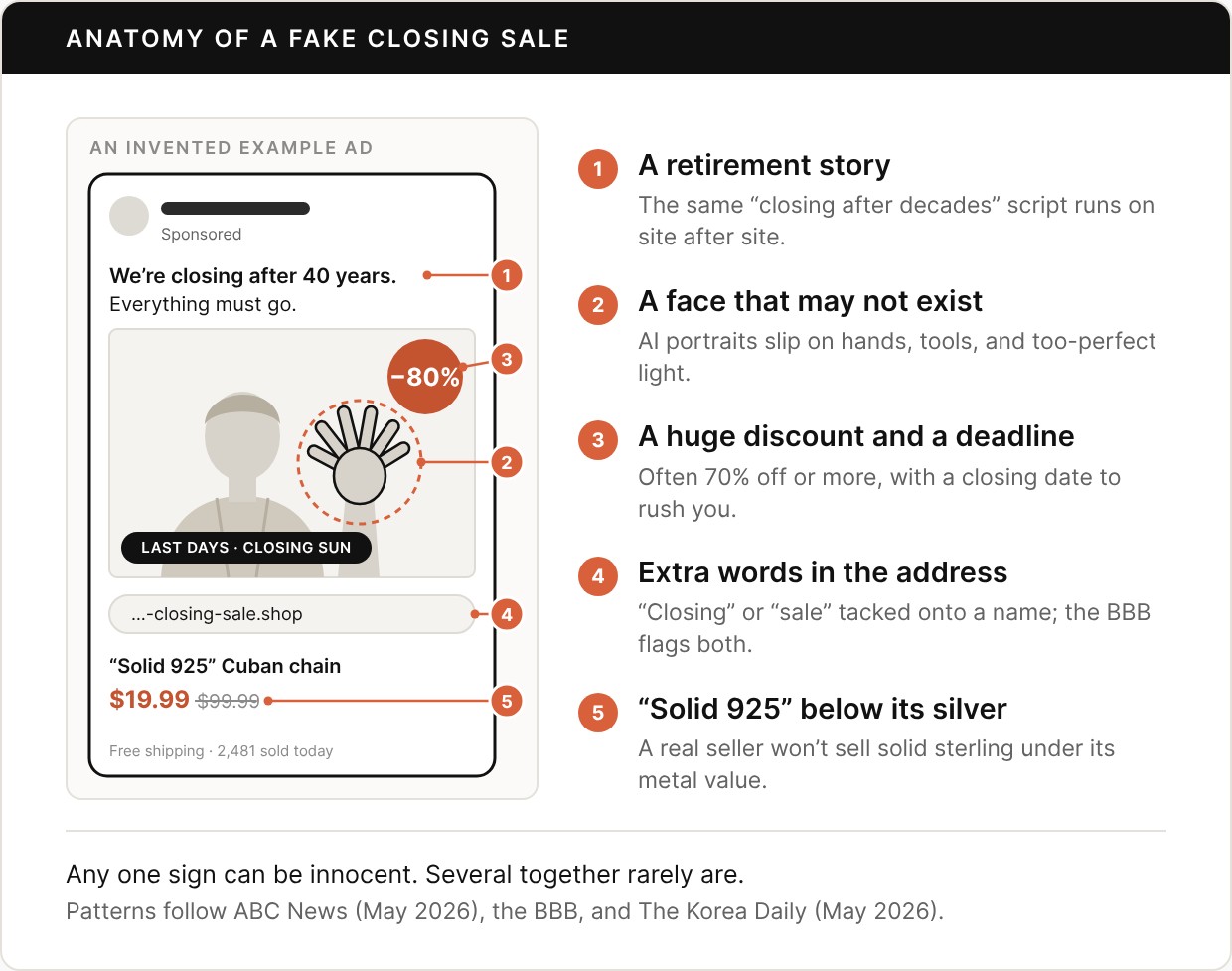
The story does the selling. ABC News found cap stores with the same retiring-owner story under different names, and nearly identical AI videos of different “craftsmen,” seemingly in the same garage, reading the same script; one buyer’s “handmade” cap shipped from mainland China. The BBB describes the same playbook for fake going-out-of-business sales: ads on social media, lookalike sites with words like “closing” or “sale” added to the address, discounts of up to 90% that grow at checkout, and tracking numbers that show the order shipping from overseas even when the store presents itself as local. Buyers then get nothing, the wrong item, or something far cheaper than pictured, and no one answers.
Jewelry is an easy fit for the scheme, because a photo can’t show whether a chain is solid sterling or plated brass. The pattern isn’t limited to the US: in July 2026, IDEX Online reported a jewelry website posing as a boutique in Cardiff, Wales, that advertised 80% off in a closing sale, used photos taken from other websites, and never delivered the orders.
The ten-minute check before you buy
None of these checks needs special tools, and each takes a minute or two. Run them before you type in a card number, especially when the store found you through an ad rather than the other way around.
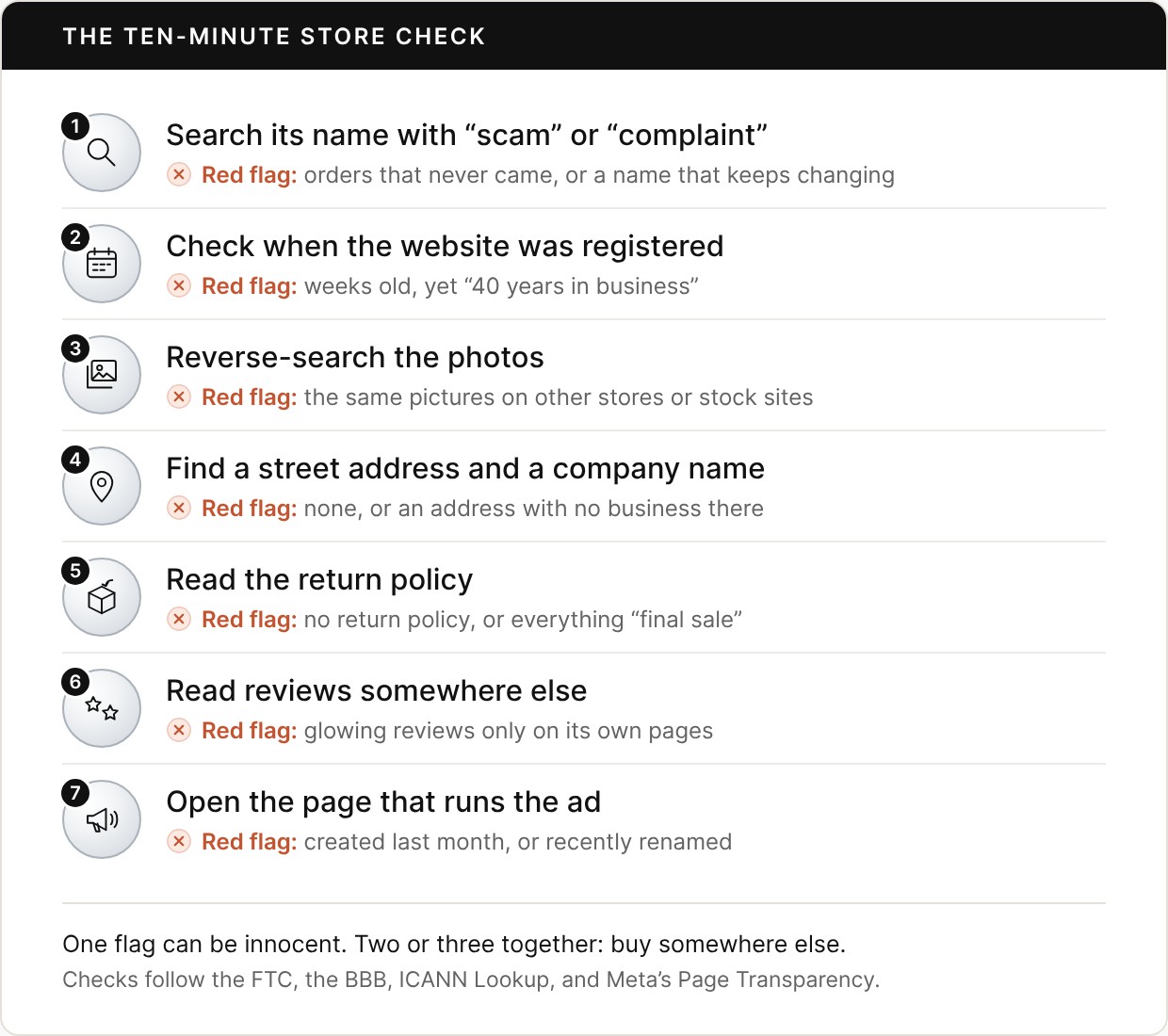
- Search the name, and the web address. The FTC suggests searching the seller’s name and the website the ad sends you to, with words like “review,” “complaint,” or “scam.” Complaints about orders that never arrived are the clearest warning. Finding nothing isn’t proof either way: these stores often disappear and reopen under new names, as The Korea Daily reported in May 2026.
- Check when the website was registered. ICANN Lookup, run by the nonprofit that coordinates internet domain names, shows a domain’s public registration record, including when it was registered. Owner details are often hidden for privacy, which is normal. What isn’t normal is a “family shop since 1985” whose website was registered a few weeks ago.
- Reverse-search the photos. Upload a product photo, or the founder’s portrait, to Google Images or TinEye. Product photos that turn up on other stores under other names mean at least one of those sellers didn’t make or photograph the piece; be wary when the same photo sits on cheap marketplace or wholesale listings, or when the store you’re checking is the newest of them. AI-made portraits and workshop scenes often go wrong in the details: hands, tools, lettering, lighting too polished for a workshop.
- Find a street address and a company name. A real business can tell you who it is: a company name in its terms or privacy policy, a street address, a way to reach a person. Look the address up on a map. When ABC News went to the upscale New York street address of a lamp company advertising its closing after two decades, it found no trace of the business.
- Read the return policy before you buy. The FTC suggests checking whether you’d get a full refund, who pays return shipping, and how long you have. A policy that sends returns overseas at your cost, charges restocking fees, or calls everything “final sale” makes a mistake expensive even when the store is real.
- Read reviews somewhere else. Reviews on a store’s own pages are easy to invent, and the FTC warns that some reviews and ratings are fake or misleading. Look the store up on independent review sites and forums, and check whether the reviews go back further than the ads do.
- Open the page that runs the ad. On a Facebook ad, tap through to the page behind it. Meta’s Page Transparency section shows when a page was created and whether it has changed its name, and the Meta Ad Library lists the ads a page is running. A page created last month, a recent rename, or a run of near-identical “closing” ads are all warnings.
Silver-specific red flags
Jewelry listings have one weakness a fake store can’t hide: silver has a market price, so the numbers have to add up.
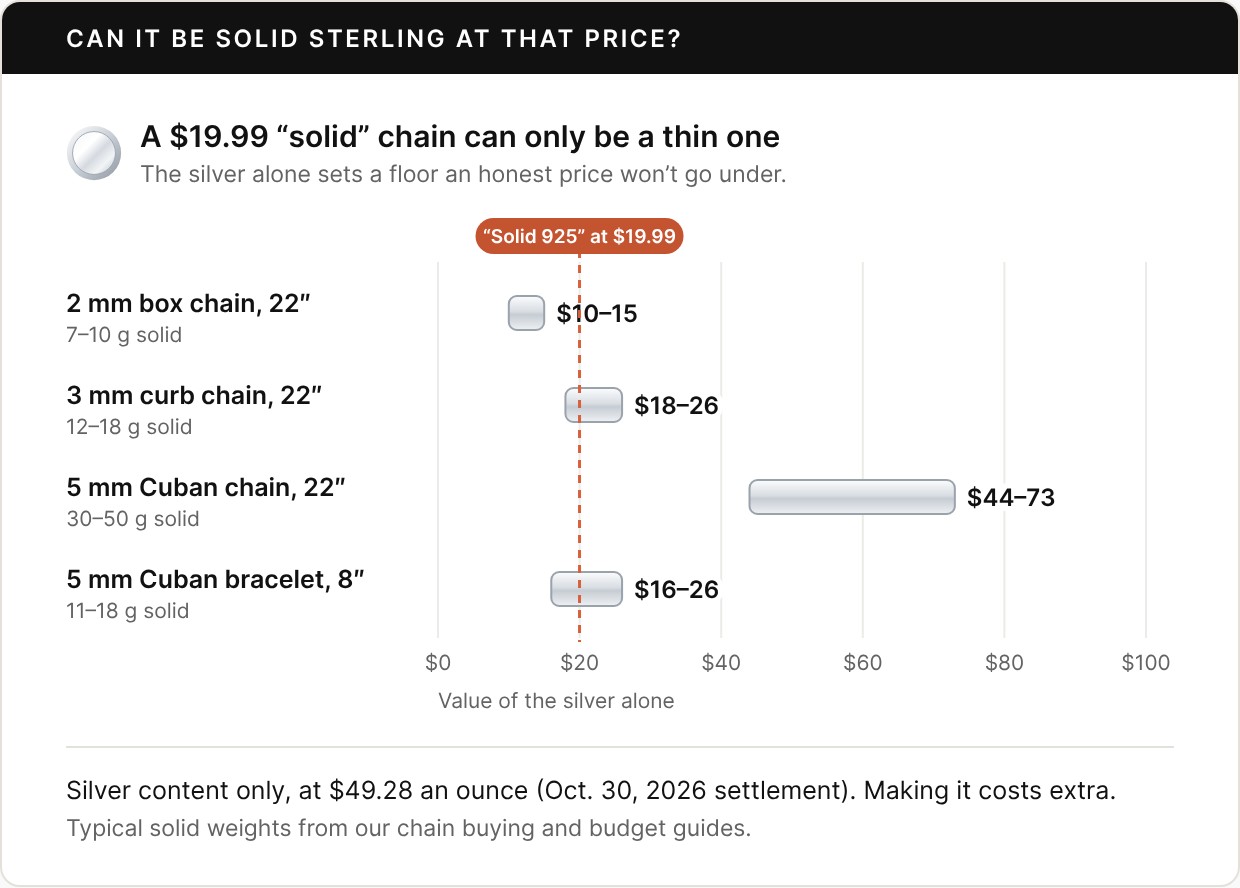
COMEX December silver futures settled at $49.28 an ounce on October 30, 2026, according to FinanceFeeds, which puts about $1.47 of silver in every gram of sterling. Our chain buying guide says a solid 22″, 5 mm Cuban chain weighs 30 to 50 grams, so it holds roughly $44 to $73 of silver before anyone has made it into a chain. A listing that offers that chain as “solid 925” for $19.99 is describing something else, most likely a hollow, plated, or base-metal chain. Our guide to what sterling silver is worth shows the math, and our budget guide shows what real pieces cost. Silver prices move, so redo the sum with the day’s price.
- “925” next to “plated,” “tone,” or “filled.” “Silver-tone” describes only the color, and “925 silver plated” and “silver-filled” describe a layer of silver over another metal; none of them is solid sterling. Our guides to what 925 means and silver-filled jewelry explain the terms.
- “German,” “Tibetan,” or “nickel” silver. These names are used for alloys with little or no silver, as our guide to German silver explains.
- No weight. A seller of solid silver can tell you what a piece weighs. If the listing doesn’t say, ask, and compare the answer with typical weights, as our Black Friday checklist suggests.
- A stamp you can’t check. A 925 stamp is easy to fake. Our guides to telling if silver is real and to cadmium in cheap “sterling” cover the tests that do work.
- “Handmade” that turns up elsewhere. If the same piece turns up on marketplace or wholesale listings in a reverse image search, a “made by hand in our family workshop” claim deserves a hard look.
How to pay so you can get your money back
Pay by credit card when you can. The FTC says a credit card gives you the strongest protection: if an item never arrives, you can dispute the charge, and for a billing error the card company must receive your letter within 60 days of the date it mailed the first bill showing the error. PayPal’s Purchase Protection covers eligible purchases, but not payments sent as Friends and Family. If a seller insists on a gift card, a wire transfer, a payment app, or cryptocurrency, the FTC says it’s probably a scam; paying through a PayPal checkout that offers Purchase Protection is different from sending money to a person.
Two more habits help with any online jewelry order. Keep the receipt and the order confirmation; they help you get your money back. A seller has to ship by the date it promised or give you the chance to cancel for a refund, and if it promises no date, an FTC rule gives it 30 days. And if a store ships from overseas, ask whether duty is included: since the $800 duty-free allowance was suspended in August 2025, an order can arrive with a bill, as our guide to duty on silver jewelry explains.
If you’ve already ordered
Move quickly; most of what protects you has a deadline.
- Call your card issuer, or open a PayPal dispute. Explain that the order never arrived or isn’t what was described, and follow up in writing, as the FTC advises. On PayPal, a dispute closes automatically after 20 days unless you escalate it to a claim, PayPal says.
- Keep everything. Save the order confirmation, screenshots of the ad and the product page, every email, and any tracking number. The ad may be gone tomorrow.
- Check anything that does arrive. Look for the stamp, weigh it, and run the simple tests in our guide to telling if silver is real while you can still dispute the charge. A disputed charge can also cover wrong or damaged goods, the FTC notes.
- Report it. File a report at ReportFraud.ftc.gov and with the FBI’s Internet Crime Complaint Center, add it to the BBB Scam Tracker, and report the ad on the platform where you saw it.
- Ignore “recovery” offers. People who have lost money get targeted again by someone offering to get it back for a fee. “Government agencies and legitimate organizations will never ask for money to help you get a refund,” the FTC says.
Not every new or overseas store is fake
Plenty of real jewelers sell only online, are new, or ship from another country, and a long delivery time or an overseas warehouse doesn’t make a store fake on its own. What sets real sellers apart is consistency: their story matches the record (the website’s age, the address, reviews that build up over time), their photos are their own, their prices make sense for the metal, and they say plainly where an order ships from, how long it takes, and how returns work. The BBB’s warning about overseas tracking numbers is about a mismatch: a store that presents itself as a local shop but ships from somewhere else.
If you’re buying a gift, give yourself room for these checks and for a return: our holiday gift guide has the order-by dates, and our guide to giving him jewelry covers what to check when the package arrives.
FAQ
How can you tell if an online jewelry store is legit?
Search its name and web address with “scam” or “complaint,” check when the website was registered, reverse-search its photos, find a company name and a street address, read the return policy, and look for reviews on independent sites. A real store passes nearly all of these; a fake one usually fails several.
Are “closing sale” jewelry ads real?
Some are. Real businesses do close and hold liquidation sales, which is exactly why the story works for scammers. Treat an ad as a starting point: go to the store’s own website by typing its address, as the BBB suggests, and run the checks above before you buy.
Is it a scam if the jewelry ships from China?
Not by itself; a lot of legitimate jewelry is made or warehoused abroad. The warning sign is a mismatch, such as a store that claims to be a local family workshop while its tracking shows the order shipping from overseas, as the BBB notes, or “handmade” pieces that turn up on other stores.
Can a 925 stamp be fake?
Yes. A stamp is easy to strike on plated or base metal. Our guide to telling if silver is real covers the magnet, ice, weight, and cloth tests, and our guide to cadmium in fake 925 explains why a very cheap “sterling” piece can be a health risk as well as a rip-off.
What if the jewelry arrived but looks nothing like the photos?
Contact the seller first and keep the messages. If that goes nowhere, dispute the charge with your card issuer or open a PayPal dispute for an item that isn’t as described; the FTC notes that a card dispute can cover wrong or damaged goods. Don’t wear it while the dispute is open.
Where do I report a fake jewelry website?
At ReportFraud.ftc.gov, with the FBI’s Internet Crime Complaint Center, and on the BBB Scam Tracker. Report the ad on the platform where you saw it, too, so it reaches fewer people.
Bottom line
A fake jewelry store sells a story first and a product second: a retiring maker, a deep discount, a closing date. Ten minutes of checks usually breaks the story: a name with complaints attached, a website a few weeks old, photos that belong to someone else, no address, no real return policy. For silver, do the sum the scammer hopes you won’t: a real seller won’t sell a heavy “solid 925” piece for less than the silver in it. Pay by card, keep your records, and if something feels rushed, close the tab.
Related guides
Scam patterns follow ABC News (May 8, 2026), the BBB’s page on fake going-out-of-business sales and its 2025 Risk Report, The Korea Daily (May 12, 2026), and IDEX Online (July 30, 2026). Social media figures follow the FTC (April 27, 2026). Shopping, payment, and recovery advice follows the FTC’s consumer pages on online shopping (November 2025), holiday shopping scams (November 2025), and refund and recovery scams (updated August 2026), and PayPal’s US page on Purchase Protection. The domain, photo, and ad checks use ICANN Lookup, Google Images, TinEye, and Meta’s Page Transparency and Ad Library as Meta describes them. Silver price: the COMEX December futures settlement of October 30, 2026, via FinanceFeeds; chain weights follow our chain buying and budget guides. All were checked on November 1, 2026. Read our editorial policy.

