November is Native American Heritage Month, a good time to support Native artists, and a good reason to know exactly what you’re buying. Imitations are common, and selling one as Native-made is a federal offense: in January 2026, a Florida man was sentenced for falsely telling customers that jewelry mass-produced in the Philippines was handmade by Pueblo Indians, according to a Justice Department release posted by the Indian Arts and Crafts Board. This guide covers what makes a piece Native American made under US law, how Navajo, Zuni, and Hopi silverwork differ, the pieces men often wear, how to check a piece and its seller, where to buy, and how to wear it with respect.
Key takeaways
- “Native American,” “Indian,” or a tribe’s name on a listing is a legal claim about who made the piece: under the Indian Arts and Crafts Act, the maker has to be a member of a federally or officially state-recognized tribe, or an artisan certified by a tribe, and if the listing names a tribe, of that tribe.
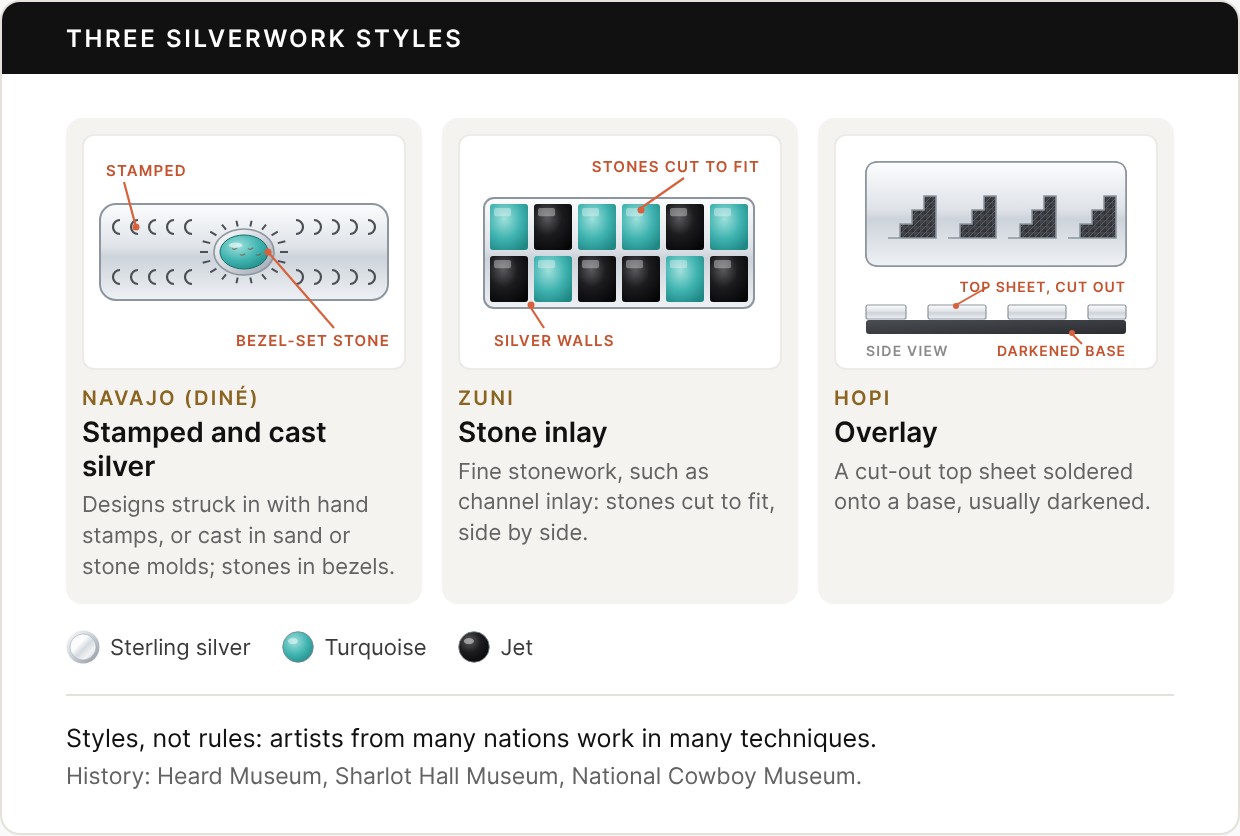
- Broadly, Navajo silver is known for stamped and cast work, Zuni for fine stonework such as channel inlay, and Hopi for overlay, a cut-out sheet over a base that is usually darkened. Knowing the look helps you ask the right questions.
- Ask for the artist’s name and tribe, and get them on a receipt with the price. A hallmark helps, but hallmarks can be faked.
- Buy from the artist, a juried market, a museum shop, or a dealer who puts the details in writing; be wary of bargain prices, many nearly identical pieces, and sellers who can’t name the maker.
- Wear it. Native designers interviewed by Cowboys & Indians say contemporary Native fashion can be worn by everyone; regalia is different.
In this guide The law Three styles Men’s pieces Checks Where to buy Price Wearing it FAQ
What “Native American made” means under US law
The Indian Arts and Crafts Act of 1990 is, in the words of the Indian Arts and Crafts Board (IACB), a “truth-in-advertising law.” It makes it illegal to offer, display, or sell art or craft products in a way that falsely suggests they are Indian-produced, or the work of a particular tribe or artist. Under the Act, an Indian is a member of any federally or officially state-recognized tribe, or an individual certified as an Indian artisan by a tribe. So jewelry advertised as “Navajo Jewelry” breaks the law if the maker isn’t a member of the Navajo Nation or a certified Navajo artisan, the IACB explains.
The penalties are serious. For a first violation, an individual can face up to a $250,000 fine, up to five years in prison, or both, and a business can be fined up to $1,000,000, according to the IACB; its brochure notes that those maximums apply to sales of $1,000 or more, with lower limits below that. In the Florida case, the seller told customers he was a Pueblo Indian from New Mexico; he received three years of probation and a $25,000 fine.
Two more things are worth knowing. The Act is about who made a piece, not what it’s made of, as our guide to turquoise and silver explains. And vague wording is often the giveaway: in its guide to Navajo weavings, the IACB notes that terms like “Navajo inspired” or “Navajo designed” usually signal a weaving that isn’t authentic, and the same caution makes sense for jewelry sold as “Native style” or “Southwest inspired.”
Navajo, Zuni, and Hopi silver: how the styles differ
Southwestern Native silverwork dates to the mid-1800s, and each tradition has its own look. Here is what to recognize, with the history behind it.
Navajo (Diné): stamped and cast silver
In the mid-1830s, Navajo men engaged two blacksmiths, Ramon Sena of Santa Fe and José Castillo, to teach them the basics, according to the Heard Museum. In 1853, Atsidi Sani, credited as the first Navajo silversmith, came to watch a Mexican silversmith at the new Navajo agency. Silver was never mined by Native people of the Southwest: smiths worked old Spanish and Mexican coins, traders imported Mexican pesos in the 1870s, and American coins came later. Smiths began setting turquoise around 1880; by the late 1880s they were stamping flat bracelets, and by the 1890s stones in bezels were common on every form of jewelry. Casting came from Mexican silversmiths, or plateros, first in sand and then in carved tufa stone molds. On a man’s cuff, ring, or buckle, look for patterns struck with hand stamps, cast forms, and stones in bezels.
Zuni: stones set in silver
Lanyade, described as the first Zuni silversmith, was making hoop earrings in the 1890s, the Heard Museum notes, and bow guards decorated with tin were collected at Zuni Pueblo in 1879, a style later made in silver. Zuni work is widely known for its fine stonework: in channel inlay, a technique the National Cowboy Museum credits the Zuni with developing, stones are cut to fit and set side by side in silver cells.
Hopi: overlay
Hopi overlay is the youngest of the three. By 1938, Mary-Russell Ferrell Colton of the Museum of Northern Arizona had turned to Hopi silverwork, and in a letter to the IACB she wrote that Hopi silver “must be absolutely unique.” After World War II, a GI Bill program trained Hopi veterans as silversmiths, with Fred Kabotie teaching design and Paul Saufkie teaching technique, according to the Sharlot Hall Museum. Overlay was first shown at the 1949 Hopi Craftsman Exhibit. The design is cut out of a polished top sheet, which is soldered onto a base sheet; the artist may texture the visible base or oxidize it to darken it. A darkened base needs the same care as any oxidized silver.
These are styles, not rules. Artists from many nations work in silver, and many combine techniques, so an artist’s name and nation tell you more than the look does. A piece labeled “Hopi overlay,” for example, has to be made by a Hopi artist; overlay by a Navajo artist is Navajo overlay, and a non-Native maker can’t use any tribe’s name.
Cuffs, rings, bolo ties, and buckles
- Cuff bracelets. A cuff is sized by its inside measurement and the gap, not by a chain length; our bracelet size guide shows how, and our comparison of cuffs and chain bracelets covers how each wears.
- Rings. Measure your US size first with our ring size guide. A ring with stamping or stones all the way around is hard or impossible to resize, as our guide to resizing a silver ring explains, so buy the right size.
- Bolo ties. Arizona declared the bolo tie its official state neckwear in 1971, the Associated Press reported, and New Mexico adopted it as its official state tie in 2007. When the Heard Museum showed 350 bolo ties in an exhibit that opened in 2011, it traced Native designs from small silver slides with a single turquoise stone to elaborate pieces with many stones.
- Belt buckles and bow guards. Buckles show off stamping and casting at a size a ring can’t. Bow guards, worn on the wrist, are an old form: leather bow guards trimmed with tin were collected at Zuni in 1879, and smiths later made them in silver.
How to check a piece and its seller
Most of the work is asking the right questions and getting the answers in writing.
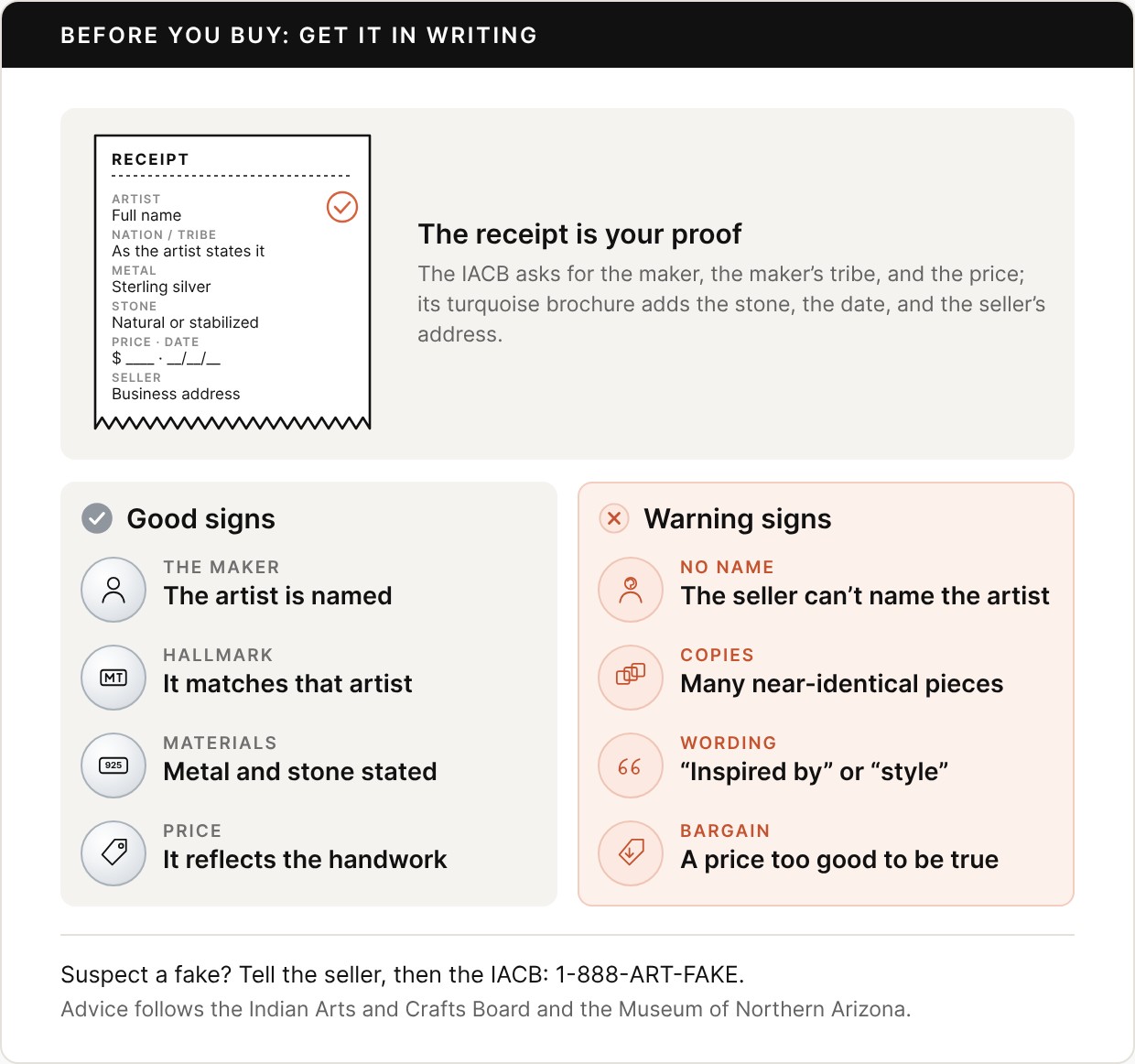
- Ask who made it. Get the artist’s name and tribe, and a receipt that shows the price, the maker, and the maker’s tribal affiliation, along with a written guarantee of authenticity, as the IACB recommends. The Museum of Northern Arizona counts a seller who can’t name the artist among the warning signs.
- Look for a hallmark, then check it. Authentic pieces usually carry the artist’s signature or hallmark, and a missing one can signal a counterfeit, the Museum of Northern Arizona notes, but fake hallmarks exist too. Make sure the mark matches the artist named on the receipt; older pieces are often unmarked.
- Check the silver. Ask whether it’s sterling and look for the mark, as our guide to what 925 means explains. “Nickel silver” and “German silver” contain no silver, as our guide to German silver shows; it has its own long history in Native metalwork, so it isn’t a sign of a fake, just not sterling, and it should be labeled and priced that way. Our guide to telling if silver is real covers simple tests.
- Ask about the stones. Natural, stabilized, block, and imitation turquoise are very different things, and the receipt should say which; our turquoise guide explains the labels.
- Know what “handmade” covers. Bargain prices, many nearly identical pieces, and a seller who can’t name the artist are warning signs, the Museum of Northern Arizona says. It adds that even a Native seller’s pieces may not be fully handmade: “stringer” jewelry is assembled from prefinished stones bought at craft stores or gem shows. Jewelers who cut their own stones often display raw stones and tools.
- Online, message the artist. Identity is hard to verify online, so the Museum of Northern Arizona suggests messaging the artist to ask about their background. Our guide to spotting a fake jewelry store covers the checks for the website itself.
- Report a suspected fake. Tell the seller first, then the IACB at 1-888-ART-FAKE (1-888-278-3253) or online, where you can file anonymously, its Know the Law brochure says.
Where to buy
The Museum of Northern Arizona points buyers to juried markets run by reputable institutions such as accredited museums, where artists must document their tribal status, and to gift shops affiliated with accredited museums. At galleries and gift shops, ask for the details about the piece and the artist in writing on the sales slip. Be more careful at flea markets and powwows, where artists aren’t vetted, the museum says; before buying at a powwow or fair, the IACB suggests checking the event’s policy on authenticity.
The IACB also publishes a Source Directory of cooperatives, tribal arts and crafts enterprises, and businesses and galleries run by enrolled members of federally recognized tribes, with artists and designers among the listings. To be listed, a business documents its owner’s tribal enrollment and certifies that most of what it sells is made by members of federally recognized tribes. The details come from the businesses and are for general information, the IACB says, so still ask who made the piece you’re buying.
Why it costs more, and why not to haggle
Handmade work takes time, and the price reflects it. The IACB warns that authentic handmade pieces may be expensive and that a price that seems too good to be true deserves more questions. The silver itself is a small part of what you pay, as our guide to what sterling is worth shows; most of the rest is the work: design, hours at the bench, the stones, and, at a gallery, the dealer’s margin.
Don’t bargain with the artist. “Negotiating the price of artwork with an artist is not appropriate,” the Museum of Northern Arizona says. Anishinaabe artist Sarain Fox made the same point to Cowboys & Indians: “You would never go into a Louis Vuitton store and offer what you want for a handbag.”
Wearing it with respect
Buying from a Native artist is the respectful part. Anishinaabe/Temagami First Nation designer Lesley Hampton told Cowboys & Indians to make sure you’re buying from an Indigenous designer, not an “Indigenous inspired” brand. Comanche, Kiowa, and Cherokee designer Peshawn Bread believes contemporary Native fashion can be worn and appreciated by everyone, and draws a line at regalia: “If it looks like it belongs in a museum, you probably shouldn’t wear it out to the club.” If you’re worried about how a piece will be perceived, Bread adds, you probably shouldn’t wear it; if you bought something from a Native designer and you love it, wear it. Fox’s advice is to wear Indigenous work “with pride and with a story,” which starts with knowing who made it.
Care is the same as for any sterling with stones: clean it gently, keep stone-set and darkened pieces out of silver dips, foil baths, and ultrasonic cleaners, and follow our guides to cleaning sterling silver and caring for turquoise.
FAQ
How can you tell if Native American jewelry is real?
Ask for the artist’s name and tribe, check that any hallmark matches that artist, and get a receipt that names the maker, the maker’s tribe, the price, the metal, and the stone. Buy from the artist, a juried market, a museum shop, or an established dealer, and be wary of bargain prices and many nearly identical pieces.
What’s the difference between Navajo, Zuni, and Hopi jewelry?
In broad strokes, Navajo silver is known for stamped and cast work with stones in bezels, Zuni for fine stonework such as channel inlay, and Hopi for overlay, a cut-out top sheet soldered onto a base that is usually darkened. Many artists work across techniques, so the maker matters more than the look.
Is it OK for a non-Native man to wear Native American jewelry?
Generally, yes, if it’s contemporary work bought from a Native artist or a dealer who names the artist. Designers interviewed by Cowboys & Indians say contemporary Native fashion can be worn by everyone. Regalia is the exception, and if you’re worried how a piece will be perceived, you probably shouldn’t wear it.
What does “Native American style” mean on a listing?
It describes a look, not a maker, and often signals that no Native artist made it. The Indian Arts and Crafts Act bars selling work in a way that falsely suggests it is Indian-made, and the IACB treats terms like “Navajo inspired” as a sign of imitation in its weaving guide. If you want a Native-made piece, ask the seller directly who made it.
Does a hallmark prove a piece is authentic?
No. A hallmark helps, and authentic pieces usually have one, but marks can be faked, and older pieces are often unmarked. Check that it matches the artist named on your receipt, and buy where the artist’s identity has been checked, such as a juried market.
Where do I report fake Native American jewelry?
Tell the seller first, then the Indian Arts and Crafts Board at 1-888-ART-FAKE (1-888-278-3253) or through its online form, where you can file anonymously.
Bottom line
“Navajo,” “Zuni,” “Hopi,” or “Native American” on a piece of jewelry is a promise about who made it, and US law backs that promise. Learn the looks (stamped and cast Navajo silver, Zuni stone inlay, Hopi overlay), then ask the questions that matter: who made it, what nation, what metal, what stone. Get the answers on a receipt, buy from the artist or someone who can vouch for them, don’t haggle with the artist, and wear what you buy.
Related guides
The law, penalties, buying tips, the Source Directory, and reporting follow the Indian Arts and Crafts Board (the Act, consumer tips, the 2019 Know the Law brochure, the 2017 Navajo weaving brochure, and the Justice Department release on the Florida case it posted in January 2026). History follows the Heard Museum’s Southwest Silverwork, 1850–1940; the Sharlot Hall Museum (Hopi overlay); and the National Cowboy Museum (Zuni channel inlay). Buying advice follows the Museum of Northern Arizona’s buying guide; quotes from Native designers and artists follow Cowboys & Indians (October 2024). Bolo ties follow the Associated Press (November 2011) and New Mexico’s State Bolo Tie page. Native American Heritage Month was first designated by a 1990 joint resolution, as FERC notes. All were checked on November 1, 2026. Read our editorial policy.

