
An evil eye charm is an eye-shaped amulet believed to protect against envious looks. The classic is a blue glass bead with a dark center: the Turkish nazar or the Greek mati. A man can wear one on a bracelet, a pendant, or a ring. There’s no rule about which wrist, and jewelers don’t agree on one; the practical choice is the wrist without your watch. Jewelry that means something is having a moment. Coveteur says it started to take notice of the medallion resurgence when Zoë Kravitz wore eye-shaped medallion earrings to the 2026 Met Gala, and concluded that “we all just want some of the things we wear to mean something.” In October, John Hardy introduced a talisman collection that National Jeweler said reflects “two current jewelry trends: medallions and personalized pieces that tell a story.” Here is what the evil eye means, what its colors are said to mean, how it’s made in silver, and how to wear and care for one.
Key takeaways
- It’s a belief about envy. The evil eye is the idea that a look can do harm; the charm is meant to protect against it.
- Blue is traditional. The classic bead has rings of dark blue, white, and light blue around a black center. Other colors are sold today, and the meanings given to them come from jewelers’ charts.
- Either wrist. There’s no fixed rule, so let your watch decide: wear the eye on the other wrist.
- Glass and enamel need gentle care. Keep them out of silver dips, ultrasonic cleaners, and the baking soda and foil bath.
- If it cracks, tradition says it absorbed a strong negative force, and the custom is to replace it.
In this guide Meaning Colors Which wrist In silver Wearing it If it breaks Faith Care FAQ
What the evil eye means
The evil eye is a belief that a look, usually an envious one, can cause harm. “The ‘evil eye’ is a supernatural belief that is culturally very widespread and which has a long history,” notes the Science Museum Group in Britain, adding that glass eye beads, or nazars, are “one of the commonest forms of evil eye amulet.” Many cultures in the Mediterranean and the Middle East believe in the evil eye, according to the Center for Russian, East European, & Eurasian Studies at the University of Kansas (KU), which notes a similar belief in countries including Greece, India, Pakistan, Iran, Iraq, and Armenia.
- The nazar (Turkey). The word comes from Arabic, KU notes. The bead, the nazar boncuğu, is still made by traditional methods in Görece and Nazarköy, two villages in İzmir province, according to the İzmir Provincial Directorate of Culture and Tourism. In Turkey it hangs in homes, workplaces, and cars, is given to newborns, and is worn as jewelry, Al Jazeera reported.
- The mati (Greece). Mati is Greek for eye. Greek families often give “a tiny gold or silver pin with a mati charm to hang by newborns’ cribs,” Religion News Service reported.
- The hamsa. A hand-shaped amulet; My Jewish Learning notes that Jews have used amulets against the evil eye, particularly the hamsa.
Glass beads decorated with eyes go back a long way. The Metropolitan Museum of Art holds a Greek one from about the 4th century BCE, a gray bead “covered with white and blue eyes,” and the Science Museum Group has a glass amulet said to have been carried by a soldier stationed in Palestine during World War I.
What the evil eye colors mean
The traditional bead is blue. KU describes concentric circles “in dark blue, white, light blue and black,” sometimes with a yellow or gold edge, and in Greece the cerulean blue mati is “still the most traditional,” RNS reports, though “today you’ll find variations in pink and even multicolored bracelets for kids.”
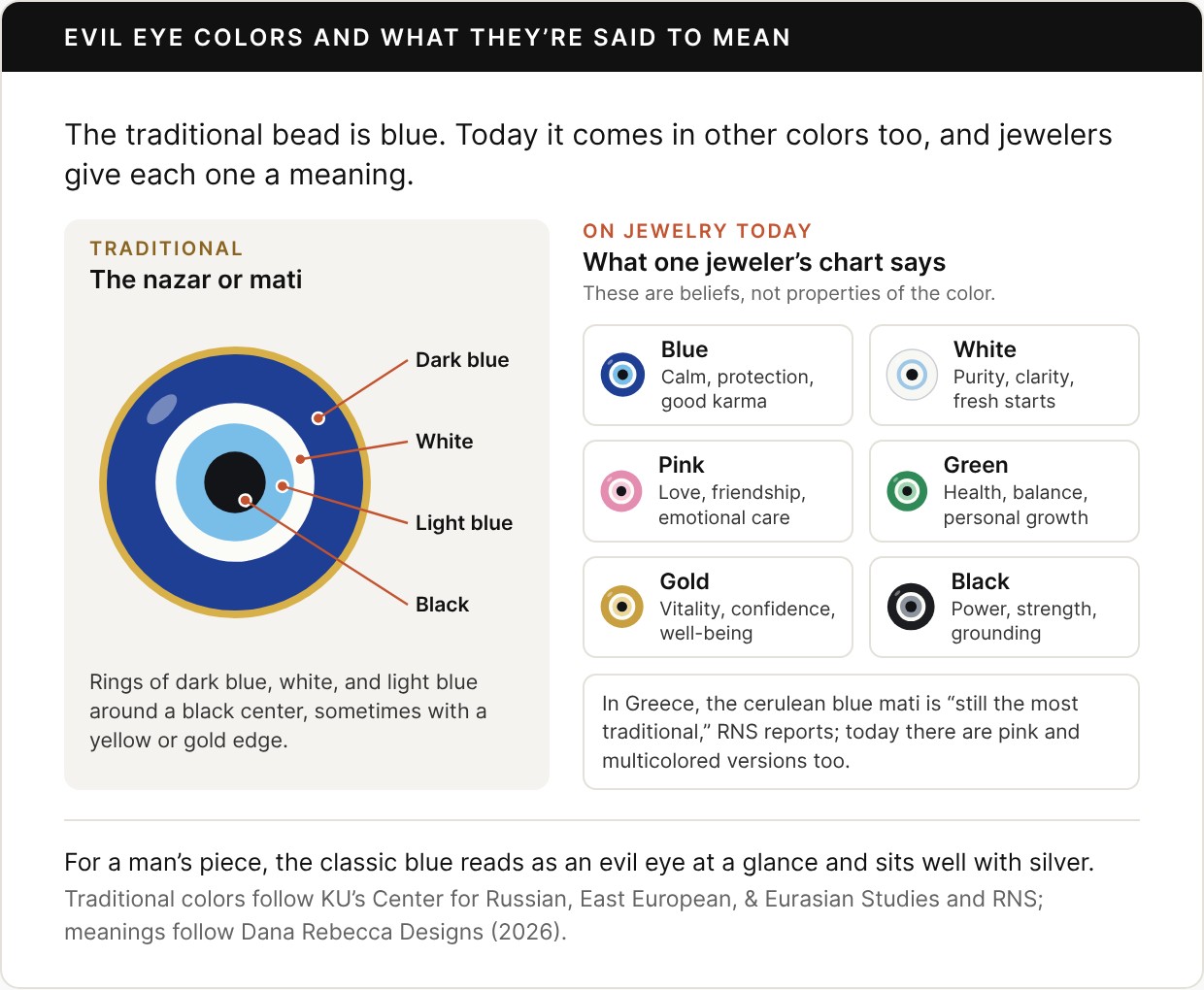
Dana Rebecca Designs, a US jeweler, gives each color a meaning. Its chart lists blue for “calm, protection, good karma,” green for “health, balance, personal growth,” pink for “love, friendship, emotional care,” and black for “power, strength, grounding.” Treat them as beliefs, not as anything the color does.
For a man’s piece, the classic blue is the easiest choice: it reads as an evil eye at a glance, and dark blue and black sit well with silver. Black with silver is the quieter option.
Which wrist to wear it on
There’s no rule, and jewelers don’t agree. Dana Rebecca Designs notes that “many traditions consider the left side of the body the receiving side, closest to your heart,” and links the right with action, but concludes: “No hand is wrong.” Ritani suggests the left wrist to protect your personal life and the right to guard your career or business.
- The practical choice. Wear it on the wrist without your watch, as our guide to wearing a bracelet with a watch suggests for any bracelet, so the eye never knocks against the watch. For most right-handed men, that’s the right wrist.
- Prefer the left? If your watch is there too, one slim, snug bracelet can share the wrist on the hand side of the watch, as our guide to stacking bracelets explains. Keep a glass bead off the watch wrist, though: a knock against the case can chip it.
- Not a bracelet guy? An evil eye also comes as a pendant or a ring; our guide to pendant meanings covers what other symbols say on a chain.
Evil eye jewelry in silver: glass, enamel, stone, or all silver
The eye can be made several ways, and the material decides how it wears and how you clean it.
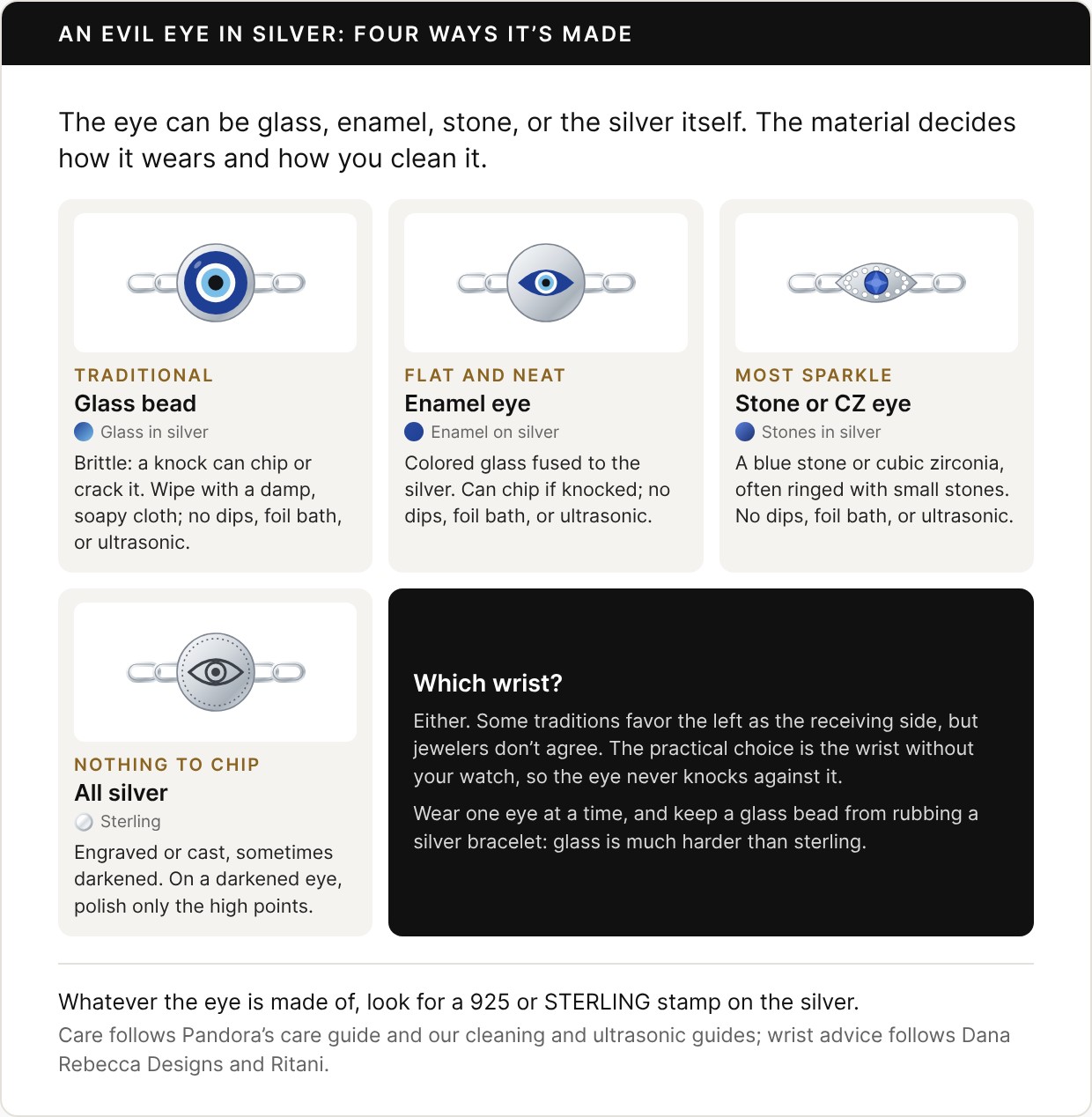
- Glass bead. The traditional eye, set in a silver bezel, hung as a charm, or strung on a cord or elastic. Glass is brittle, so a knock against a desk can chip or crack it.
- Enamel. Fired enamel is colored glass fused onto the silver, often as a small eye on a disc or a link. It sits flat and neat but can chip if knocked.
- Stone or cubic zirconia. A blue stone or a CZ eye, often ringed with small stones. If the blue is turquoise, our guide to turquoise and silver explains what natural, stabilized, and dyed mean, and why to get the answer in writing.
- All silver. An eye engraved or cast in sterling, sometimes darkened (oxidized) to bring out the lines. With no glass or stone to chip or loosen, it’s the hardest-wearing version, and the quietest.
- Check the metal. The silver should be stamped 925 or STERLING, as our guide to what 925 means explains; “silver-tone” describes a color or a base-metal alloy, not sterling, as our beaded bracelet guide notes.
Whether a charm protects anyone is a matter of belief. A listing that promises health benefits is something else: treat it as a red flag about the seller, as our guide to silver bracelet health claims explains.
Wearing it with your other silver
- One eye at a time. A single bead or a single eye on a chain reads as a choice; several compete with each other.
- One plain piece beside it. If you stack, add one slim, plain piece at most, the limit our stacking guide sets for any medallion bracelet.
- Keep glass off your silver. Glass, like the obsidian (volcanic glass) in our beaded bracelet guide, is much harder than sterling, so a glass bead can mark a silver bracelet it rubs against. Leave a little space between them, or wear them on different wrists.
- Fit it snug. A snug fit keeps the eye on top of the wrist instead of sliding to the side, as with any centerpiece bracelet in our guide to symbols on men’s silver bracelets. Our bracelet size guide shows how to measure.
If your evil eye cracks or breaks
Tradition reads a broken bead as a sign it did its job. “If one breaks, it is said to be because the bead absorbed a particularly strong negative force,” KU explains, and “the broken amulet should be replaced as soon as possible.” The practical reading is simpler: glass breaks when it’s knocked, and cord and elastic wear out. A bead shop or jeweler can restring a beaded bracelet, as our beaded bracelet guide notes, and a jeweler can replace a cracked bead in its setting.
Faith and the evil eye
The belief crosses religions, and so do objections to the charm. If it matters to you, ask a teacher in your own tradition; here is what some religious authorities and sources have said.
- Christianity. In the Old Testament, “evil eye” seems to mean stinginess rather than a magical power, and in Matthew 20:15 selfishness or envy, according to the Encyclopedia of the Bible; the RSV, for instance, renders it “stingy” in Proverbs 23:6. The Greek Orthodox Church “considers the mati at odds with Christianity,” RNS reported, and the Rev. Demetrios Nikou, high priest of the Cathedral of Athens, told RNS that only the Christian cross gives true protection: “Religion-wise, the blue eye does not mean anything. This is a cultural symbol.”
- Islam. Turkey’s Directorate of Religious Affairs says religion accepts that some people “can create negative effects with their gaze,” but in a fatwa reported in January 2021 it said wearing evil eye amulets for protection is not permissible, because “attitudes, behaviours and beliefs that attribute the ultimate influence on anything other than Allah are forbidden,” Al Jazeera reported. Many Turks, it added, questioned why the directorate would denounce a harmless tradition.
- Judaism. The Talmud discusses the evil eye (ayin hara), and Jews have used amulets such as the hamsa against it, My Jewish Learning notes. In a separate article, it notes that “wearing a red string bracelet to ward off evil is not a practice deeply rooted in Jewish text and tradition.”
How to care for evil eye jewelry
- Polish the silver, not the eye. Use a polishing cloth on the metal and work around glass, enamel, and stones.
- No dips, foil bath, or ultrasonic. Pandora’s care guide, which covers its glass charms, advises avoiding “silver dips, polishing liquids, ultrasonic cleaning and strong chemicals.” Our guide to cleaning sterling silver reserves the baking soda and foil bath for plain sterling, and our ultrasonic guide keeps stones, glue, and cord out of the machine.
- Wipe glass gently. Pandora suggests a soft cloth dampened with lukewarm water and a little liquid soap, then a wipe with plain water and a pat dry.
- Roll elastic on. Rolling a stretch bracelet over your hand rather than pulling it wide makes the elastic last longer, as our beaded bracelet guide explains.
- Store it on its own. Keep it in its own pouch or zip-top bag so glass can’t knock against other pieces, as our tarnish guide suggests for silver.
FAQ
Can men wear evil eye jewelry?
Yes. Dana Rebecca Designs notes that the symbol “carries no gender restriction,” and in Turkey the charm is given to newborns, hung in homes and cars, and worn as jewelry. For a man, a single bead or a small eye on a silver chain bracelet is the easiest way to start.
Which hand should a man wear an evil eye bracelet on?
Either. Dana Rebecca Designs notes that many traditions call the left the receiving side but says “no hand is wrong,” and Ritani suggests the left for your personal life and the right for your career. The practical choice is the wrist without your watch, which for most right-handed men is the right.
What do the evil eye colors mean?
The traditional bead is blue, with rings of dark blue, white, and light blue around a black center. Meanings for other colors come from jewelers’ charts: one lists green for health and balance, pink for love and friendship, and black for power and strength.
What does it mean when an evil eye bracelet breaks?
Tradition says the bead absorbed a particularly strong negative force and should be replaced as soon as possible, KU notes. Practically, glass breaks when it’s knocked and elastic wears out, so have it restrung or the bead replaced.
Is it bad luck to buy yourself an evil eye?
None of the cultural sources we checked says so. The charm is often given as a gift, to newborns in Turkey and Greece, and one jeweler, Dana Rebecca Designs, says one “given with love” is considered especially powerful, but nothing we found forbids buying your own.
Is wearing an evil eye against Christianity or Islam?
Some religious authorities discourage it. The Greek Orthodox Church considers the mati at odds with Christianity, RNS reported, and Turkey’s Directorate of Religious Affairs said in a fatwa reported in January 2021 that wearing evil eye amulets for protection is not permissible. Many people still wear it as a cultural symbol; if it matters to you, ask your own priest, imam, or rabbi.
Bottom line
The evil eye is an old Mediterranean and Middle Eastern belief, and the charm against it, an eye meant to protect against envious looks, is easy to wear in silver. Choose the classic blue, or black if you want it quieter; wear one at a time, on whichever wrist suits your watch; and keep glass and enamel out of dips, the foil bath, and ultrasonic cleaners. If it cracks, tradition says replace it.
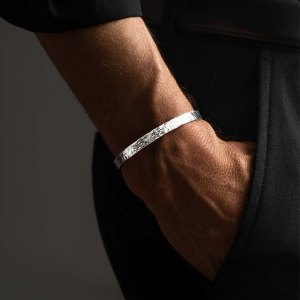
From the collection
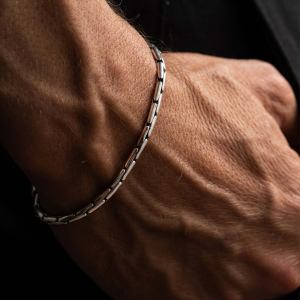
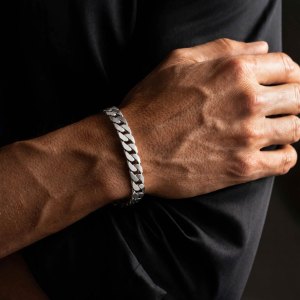
Men’s sterling silver bracelets by Ronatelli
Thirty-one 925 sterling silver bracelets, $149 to $539, from a 3.5 mm bamboo link to wide statement pieces, including seven adjustable cuffs and bangles.
Related guides
The hook follows Coveteur (August 3, 2026) and National Jeweler (October 19, 2026). The belief and its history follow the Science Museum Group, KU’s Center for Russian, East European, & Eurasian Studies, the İzmir Provincial Directorate of Culture and Tourism, Al Jazeera (January 23, 2021), Religion News Service (September 21, 2017), and the Metropolitan Museum of Art. Color meanings follow Dana Rebecca Designs (May 4, 2026), and wrist advice Dana Rebecca Designs and Ritani; faith positions follow the Encyclopedia of the Bible (Bible Gateway), RNS, Al Jazeera, and My Jewish Learning; care follows Pandora’s care guide. Ronatelli’s bracelet count and prices were checked on November 1, 2026, and all sources on the same day. Read our editorial policy.

